
Promote your contents FREE, contents such as WebSites, YouTube channels, YouTube videos, Facebook, Instagram, LinkedIn, Twitter, Pinterest and many more.
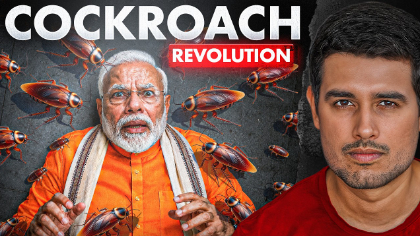
Dhruv Rathee dissects why the Modi government appears to be overly concerned with the 'Cockroach Party'. Explore the political dynamics at play.
Opening content automatically in secounds...
Or
This content was added on Promote Content at 13 Jun 2026 and got 13 visits untill now.
## Why Modi Govt is SCARED of Cockroach Party? | Dhruv Rathee: An In-Depth Analysis Dhruv Rathee, known for his incisive political commentary and deep dives into contemporary Indian issues, has once again sparked a crucial conversation with his provocative take: "Why Modi Govt is SCARED of Cockroach Party?" This title, far from being a literal interpretation, invites us to peel back layers of political strategy, power dynamics, and public perception. The term "Cockroach Party" is undoubtedly a metaphor, likely referring to a political entity, an individual, or a movement that, despite its seemingly small stature or nuisance value, garners a disproportionately strong reaction from the ruling establishment. But why would a powerful government, with a massive mandate and extensive resources, appear to be 'scared' of such an entity? This article delves into the nuances of this political phenomenon, echoing the analytical lens Dhruv Rathee often employs. ### Deconstructing the "Cockroach Party" Metaphor To understand the premise, we must first decipher what the "Cockroach Party" represents. In political discourse, such a derogatory term is often applied to an opposition group, a dissenting voice, or a grassroots movement that is perceived by the establishment as insignificant, irritating, yet remarkably resilient. It could be a regional party gaining unexpected traction, an activist group exposing inconvenient truths, or even a lone critical voice that refuses to be silenced. The 'cockroach' analogy implies something hard to eradicate, capable of surviving harsh conditions, and multiplying despite attempts to suppress it. Dhruv Rathee's use of this phrase immediately signals an examination of how power reacts to perceived irritants, irrespective of their actual size or conventional political power. ### The Illusion of Fear: Beyond Literal Scaredness The notion of the Modi government being "scared" is less about genuine terror and more about a strategic reaction to challenges. A powerful government rarely fears its literal political extinction from a small entity. Instead, the 'fear' manifests as an aggressive defensive posture, an attempt to control narratives, and a desire to maintain absolute dominance. This reaction can stem from several underlying concerns: * **Narrative Control and Ideological Purity:** The Modi government, like many strong majorities, places immense importance on controlling the national narrative. Any dissenting voice, however small, can introduce cracks in the carefully constructed edifice of its public image. The "Cockroach Party," by its very existence and persistence, challenges this narrative control, questioning policies, decisions, or the very ideological framework of the ruling party. A robust response aims to discredit, silence, or marginalize such voices before their ideas can gain wider acceptance. * **Setting a Precedent:** Allowing even a minor challenge to go unchecked can embolden others. If a "Cockroach Party" manages to successfully critique or expose an issue without facing significant repercussions, it might inspire other small groups or individuals to do the same. This can lead to a fragmentation of dissent, making it harder for the government to manage and control. Thus, a strong reaction serves as a deterrent, sending a clear message about the consequences of challenging the status quo. * **Resource Allocation and Strategic Overreaction:** When a government with vast resources dedicates significant attention—be it through media scrutiny, legal challenges, or political campaigning—to a seemingly small opponent, it signals that the 'threat' is perceived as more significant than it appears. This overreaction can inadvertently elevate the "Cockroach Party" in the public eye, giving it legitimacy and visibility it might not have otherwise achieved. It suggests that the government sees a potential, even if distant, vulnerability that needs to be addressed proactively. * **Electoral Impact and Vote Share:** In a diverse democracy like India, even a small shift in vote share can have significant electoral consequences, especially in closely contested constituencies. A "Cockroach Party," while not threatening to form a government, might disrupt vote banks, split opposition votes, or rally a niche demographic in a way that impacts the larger electoral calculus. Governments are hyper-aware of these micro-level impacts and may react strongly to neutralize such influences. * **Perception of Weakness:** Conversely, ignoring a persistent, albeit small, critic might be perceived as weakness or indifference by parts of the electorate. A strong, decisive response, even if disproportionate, can project an image of strength, control, and unwavering resolve to the government's core supporters. This is often a strategic calculation aimed at maintaining voter confidence and consolidating power. ### Dhruv Rathee's Analytical Lens: Unmasking Power Dynamics Dhruv Rathee's style often involves questioning established narratives, exposing hypocrisy, and analyzing political events through a critical, evidence-based lens. In the context of the "Cockroach Party," he would likely dissect the government's actions, scrutinize the resources deployed against it, and analyze the media's portrayal. He would ask: Is the reaction proportionate? What are the underlying motives? Who benefits from such a narrative of 'fear' or aggressive suppression? His work typically encourages viewers to look beyond the surface and understand the strategic game being played by powerful entities. He would likely point out instances where smaller political voices or critical journalists have faced disproportionate scrutiny, legal challenges, or social media campaigns, raising questions about freedom of expression and democratic health. By framing the government's reaction as 'scared,' Rathee challenges the image of an invincible, unshakeable power, forcing an examination of its vulnerabilities and strategic responses. ### Conclusion: The Uncomfortable Truth of Political Power The "Why Modi Govt is SCARED of Cockroach Party?" narrative, as presented by Dhruv Rathee, is a powerful metaphor for the complex and often uncomfortable truth about political power. It highlights that even the most dominant governments are sensitive to challenges, particularly those that threaten their narrative, ideology, or long-term strategic goals. The 'fear' is not of annihilation, but of erosion – erosion of control, credibility, and consolidated power. By examining the disproportionate reactions to seemingly minor political entities, we gain insight into the mechanisms of power, the strategies of narrative control, and the constant struggle between dissent and dominance in a democratic landscape. Dhruv Rathee's analysis urges us to critically evaluate not just the actions of the 'Cockroach Party,' but more importantly, the reactions of the powerful government, and what those reactions reveal about the health and dynamics of our political system.